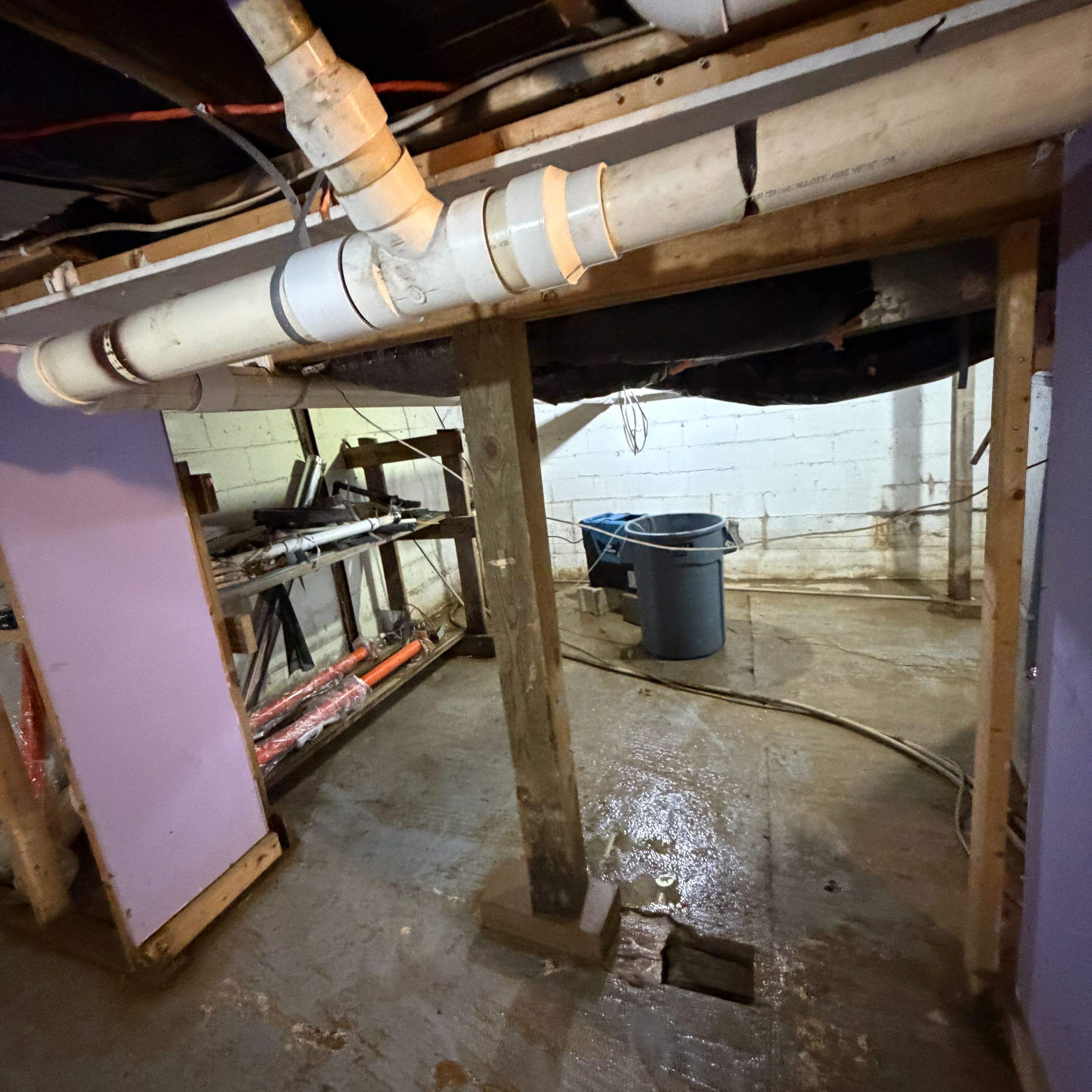
The 3 a.m. Sump Pump Failure in Lebanon
Back to the homeowner from the opener. When our lead tech arrived, he measured 3.2 inches of standing water across roughly 900 square feet of finished basement. The cause was a failed sump pump check valve combined with a tripped GFCI outlet. Category 1 clean water, but it had already been sitting four hours by the time we started extraction.
We pulled the water in under ninety minutes using two truck-mounted extractors. The carpet was glued-down commercial grade, so we made the call to save it. The pad underneath was a total loss. We cut and removed 340 square feet of pad, pulled baseboards in the affected rooms, drilled small weep holes behind the trim to release trapped water in the wall cavity, and set up 14 air movers and 3 commercial dehumidifiers. Total drying time was 72 hours with daily moisture readings logged for the insurance file. Final invoice came to $4,180. Her State Farm policy covered everything except the $1,000 deductible.
What made this job recoverable rather than a tear-out was timing. Had she waited until morning to call, the carpet glue would have started releasing, the tack strips would have begun rusting into the carpet backing, and the wall cavity moisture would have reached the insulation. That single decision to call at 3 a.m. instead of 7 a.m. saved her roughly $2,800 in additional materials and labor. We tell every Lebanon Water Restoration customer the same thing: the clock starts the moment water touches the floor, not the moment you decide to deal with it.
The Finished Basement in a Lebanon Ranch Home
A retired couple called us in August after a washing machine supply line burst while they were at church. They were gone roughly three hours. When they walked in, water was running down the basement stairs like a creek. The laundry room sat directly above the finished basement family room, and the ceiling drywall had already collapsed in two spots.
This was a more involved job. We documented Category 2 water due to the laundry detergent and the time it had been sitting. Our scope included removing the collapsed ceiling drywall, pulling 280 square feet of laminate flooring that had already buckled, cutting drywall 24 inches up on three walls (the flood cut method), and treating all exposed framing with an antimicrobial. The drying setup ran for 96 hours. We worked directly with their adjuster from Allstate and provided daily moisture logs, photos, and a detailed scope. Their out-of-pocket was the $1,500 deductible on a total mitigation invoice of $7,840. For deeper context on how appliance failures escalate, our guide on burst pipe water damage and repair cost walks through similar scenarios.
One detail worth mentioning from this job: the couple had photographs of the family room from a Christmas gathering six months earlier. Those images became part of the contents claim and helped the adjuster value a custom built-in bookshelf that had to be partially demolished. We now tell every Lebanon homeowner to keep a folder of basement photos on their phone. It takes ten minutes and can add thousands to a legitimate claim.
Where the Money Actually Goes
Homeowners often ask why a flooded basement costs what it does. In the cases above, roughly 35 percent of each invoice covered labor, 25 percent covered equipment time (air movers and dehumidifiers running 24/7 for 3 to 5 days), 20 percent covered controlled demolition and disposal, and the rest covered antimicrobial treatment, documentation, and overhead. A typical Lebanon flooded basement, between 500 and 1,200 square feet, runs $3,500 to $8,500 depending on water category and material loss. Our broader basement flooding service page covers the full range of scenarios we handle.
The Rental Property Call We Took Last Spring
A Lebanon landlord called Lebanon Water Restoration after his tenant reported a damp smell in the basement of a duplex. No visible water, no obvious source. Our tech ran a thermal scan and found a slow drip from a corroded copper fitting behind the furnace that had been wicking into the subfloor for what we estimated was three to four weeks. Mold had already started colonizing the underside of the OSB. The repair scope grew from a simple plumbing fix to a $3,200 containment, removal, and remediation job. The lesson for any property owner: a musty smell is a leak you have not found yet. Cheap moisture meters run about $30 at any hardware store and pay for themselves the first time they catch something early.
The Sewage Backup That Looked Like a Basement Flood
Not every basement flood is clean water, and that distinction changes everything. One Lebanon family called us thinking they had a groundwater issue. When our tech walked in, the smell told a different story. The municipal sewer main had backed up through their floor drain, depositing about an inch of Category 3 black water across their unfinished basement.
This required full PPE, controlled demolition of any porous materials touched by the water, and disinfection protocols that meet IICRC S500 standards. We removed stored cardboard, an old couch, carpet remnants, and the bottom 24 inches of drywall in one finished section. Total cost ran $6,900, and their sewer backup rider (a $75 annual add-on to their policy) covered all but the deductible. If you suspect sewage rather than clean water, our sewage cleanup service page explains the safety protocols in more depth.
What These Jobs Have in Common
Three different causes, three different price points, but a consistent pattern. Here is what every successful flooded basement job in Lebanon requires:
- Extraction within the first 24 hours to prevent Category 1 water from degrading to Category 2
- Moisture mapping with a calibrated meter, not a guess
- Strategic demolition only where materials cannot be dried in place
- Air mover and dehumidifier counts based on cubic footage and material type, not a flat formula
- Daily documentation that holds up to any insurance adjuster review
We have walked away from jobs too. One homeowner in a Lebanon neighborhood had a small leak from a water heater pan that had already air-dried over a weekend before he called. We tested the drywall and subfloor, found readings within normal range, and told him directly that he did not need mitigation. He paid for the inspection, which ran about $185, and that was it. If we cannot help, we will tell you directly. That promise is why our phone keeps ringing.